
Product sheet
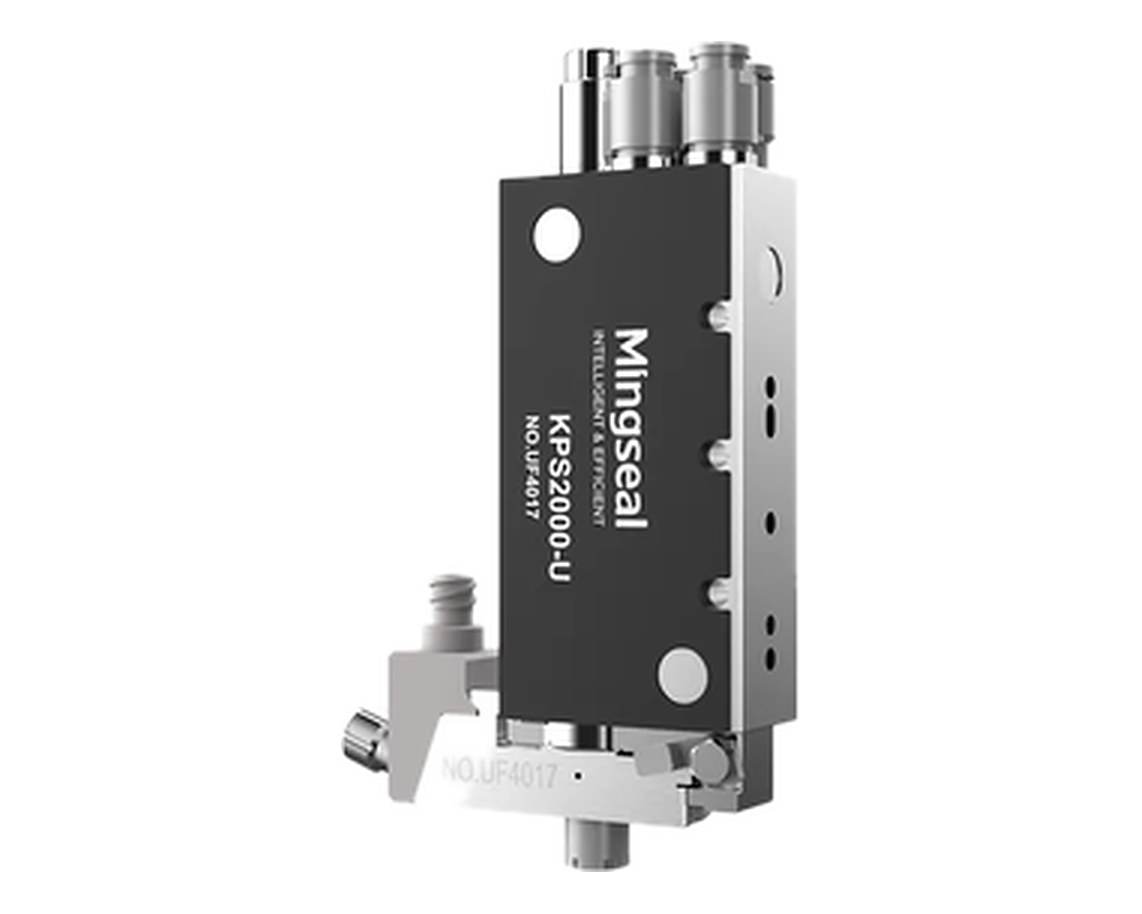
The KPS2000-U is a high-precision piezoelectric valve that provides precise, controlled fluid dispensing for compact camera modules and small assemblies and similar. It dispenses adhesives, lubricants and sealants stably and repeatably where space is limited and placement must be accurate.
Choose it when you need fine control of bead or dot size and easy integration on compact tool heads. It is driven by the KPC2000.
The problem
Camera module production often fails when the dispenser cannot form small, even beads or dots in tight spaces. Poor control leads to adhesive overflow, contamination of the optics and more scrap.
The cause
Many valves only fire all-or-nothing shots or simple pulses, which prevents fine variation of the flow for small details. Oversized valve bodies or poorly finished channels prevent access to small parts, and unstable pressure or control changes the shape and volume of the bead.
The KPS2000-U answer
This proportional piezo valve varies the quantity of product continuously and precisely: short beads or exact dots, without repeated adjustments. Its compact body and low-profile nozzles allow it to reach confined areas inside camera modules.
Progressive adjustment of bead width and dot volume.
Repeatable dispensing in tight assemblies.
Less risk of optical contamination or adhesive overflow.
Simple adjustment and easy mounting on compact robot heads.
Adhesive dots for lens seats, spacer bonding or lens edge sealing.
Small beads in narrow connector cavities.
Precise placement of index-matching gels or adhesives near lenses and sensors.
Controlled dispensing where the shape of the part limits nozzle access.
| Input air pressure | 0.1 to 8 bar |
| Product viscosity | Medium- or high-viscosity products Max. 500,000 mPa·s |
| Minimum dispensed quantity | 0.5 nL (CPK > 1.33) |
| Continuous jet frequency | 1,200 Hz |
| Dimensions (W × D × H) | 125.5 × 40 × 20 mm (without fluid housing) 125.5 × 75 × 20 mm (with fluid housing) |
| Weight | 440 g (with fluid housing) |
| Certification | ISO · RoHS |
The valve uses a piezoelectric element that changes the volume of the fluid chamber in proportion to the control signal. By varying the amplitude and duration of the signal, progressive flow variations are obtained. A stable inlet pressure and a well-chosen nozzle keep the meniscus stable for reproducible dispensing.
Choose this valve when you need variable flow, a compact format and mounting close to the parts:
Define the target bead width or drop volume and choose the closest nozzle.
Specify the viscosity at working temperature; request a trial if it exceeds 100,000 cps.
Check the required placement speed and that the valve response time suits your cycle.
Choose the wetted materials according to the fluid chemistry (316L stainless steel for general use; PTFE or ceramic for aggressive fluids).
Check the mounting space and flange type for fixing on the robot or tooling.
Plan a short tuning session for the control signal, pressure and nozzle offset.
Trials with your own products can be carried out in our laboratory. Discover our testing services
Let's talk about your application
Tell us which fluid you dispense, at what rate and with what tolerance: we will propose the right configuration, a detailed quotation and, if you wish, a trial on your own parts in our laboratory.
CDS Electronique · Bussy-Saint-Martin (77) · Mon–Thu 9am–6pm · Fri 9am–12pm