
Product sheet
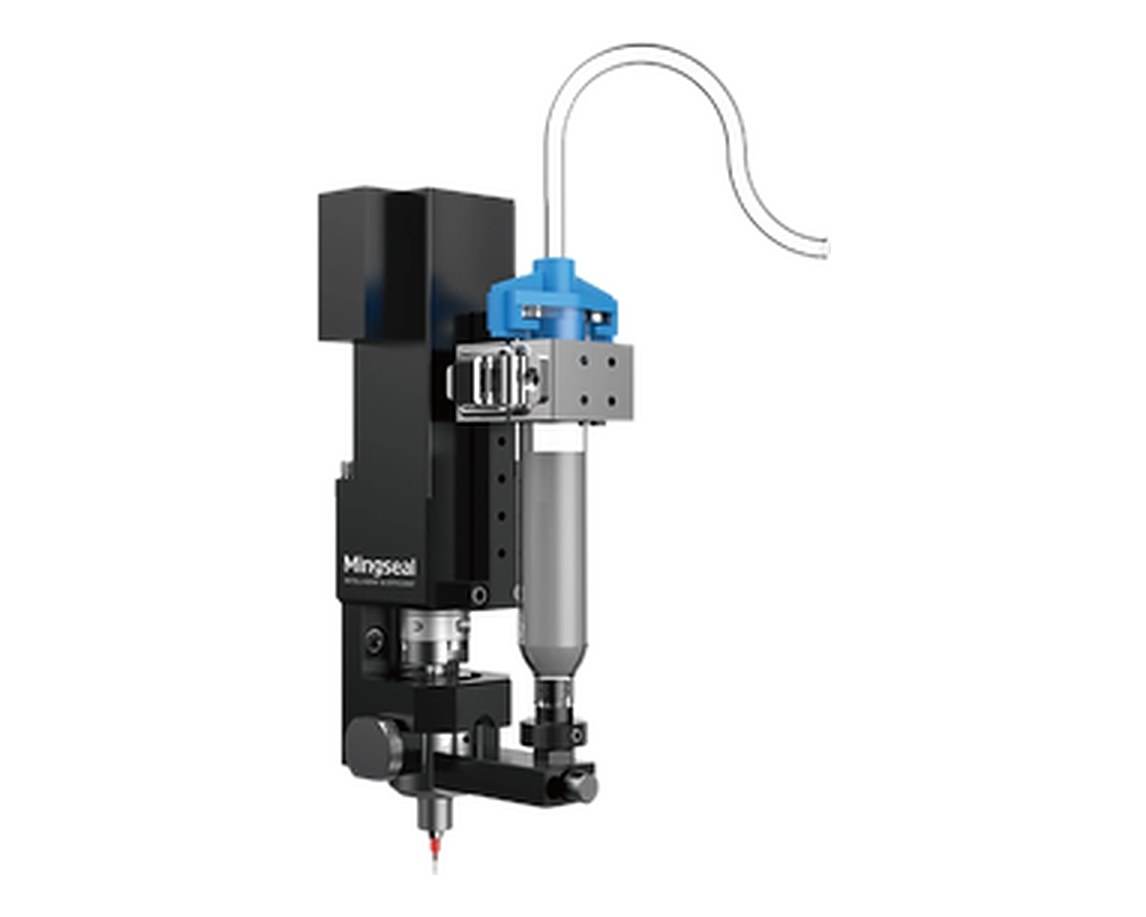
The KSV1000 is a high-precision screw valve that dispenses hot-melt adhesives and filled adhesives using a concentric screw rotating at 10 to 500 rpm. It handles viscous products from about 5,000 to 500,000 cps and delivers a steady output, with repeatability close to 98% after tuning.
Its short fluid channel, quick-release head and replaceable wetted parts simplify cleaning and reduce downtime. It is driven by its own controller.
The problem
Many hot-melt adhesive lines suffer from beads of varying width, missed deposits or frequent stoppages for cleaning: more scrap and a slower rate.
The cause
Thick adhesives require positive displacement and a stable feed. Pressure pumps or pumps with tight clearances pulse, trap air or wear quickly with heavy pastes. A poorly chosen nozzle or unstable motor control further increases variations.
The KSV1000 answer
Volumetric positive-displacement dispensing: the flow follows the screw speed linearly. The concentric screw reduces dead volumes and air pockets; a replaceable mixer and nozzle and robust materials reduce maintenance.
Concentric screw from 10 to 500 rpm: the flow follows the motor speed, for a steady output.
After tuning, for adhesives from 5,000 to 500,000 cps.
The short central channel reduces trapped air and dead volumes: even bead profile and less clogging.
Quick-release head and replaceable wetted parts: simplified cleaning and fewer stoppages.
Adhesive dots and beads for connectors, housings and modules.
Dispensing of gap fillers and thermal adhesives for vapour chambers.
Structural bonding in power modules or motor assemblies.
Feeding downstream dispensers or dispensing beads directly onto a conveyor.
For long runs where stoppages must be kept to a minimum.
| Type | Screw valve |
| Operating modes | Timed, linked |
| Rotor speed | 10 to 500 rpm |
| Adhesive viscosity | 5,000 to 500,000 cps |
| Dispensing trigger | Dispensing button, trigger interface (24 V active and passive) |
| Output signals | "Dispensing" output, fault output |
| Other functions | Instant suck-back, RS-232C communication, Chinese / English display |
| Stator material | Stainless steel |
| Screw material | Tungsten steel |
| Valve dimensions (without cables) | 37 × 230 × 85 mm (W × H × D) |
| Controller dimensions | 240 × 100 × 260 mm (W × H × D) |
| Certification | ISO · CE |
The concentric screw rotates and pushes the product forward: the rotation speed sets the flow rate, which therefore follows the motor speed. The short central channel reduces trapped air and dead volumes. The product reaches the mixer or nozzle, where the bead width and deposit size are set by the nozzle diameter and the motor pulse duration. For very heavy pastes, a higher speed and a larger nozzle improve the flow.
Specify the viscosity at working temperature and the nature of any fillers, to size the screw and clearances.
Define the maximum and average flow rate per head and choose a model with some margin.
Choose the nozzle diameter according to the target bead width or dot size.
Choose the feed: pressurised reservoir for long runs, bulk feed for large volumes, with a stable regulator.
Plan PTFE or ceramic parts for abrasive or reactive adhesives.
Add an encoder or flow sensor if closed-loop verification is required.
Request a trial with your product to set the speed, nozzle and temperature.
Trials with your own products can be carried out in our laboratory. Discover our testing services
Let's talk about your application
Tell us which fluid you dispense, at what rate and with what tolerance: we will propose the right configuration, a detailed quotation and, if you wish, a trial on your own parts in our laboratory.
CDS Electronique · Bussy-Saint-Martin (77) · Mon–Thu 9am–6pm · Fri 9am–12pm