
Product sheet
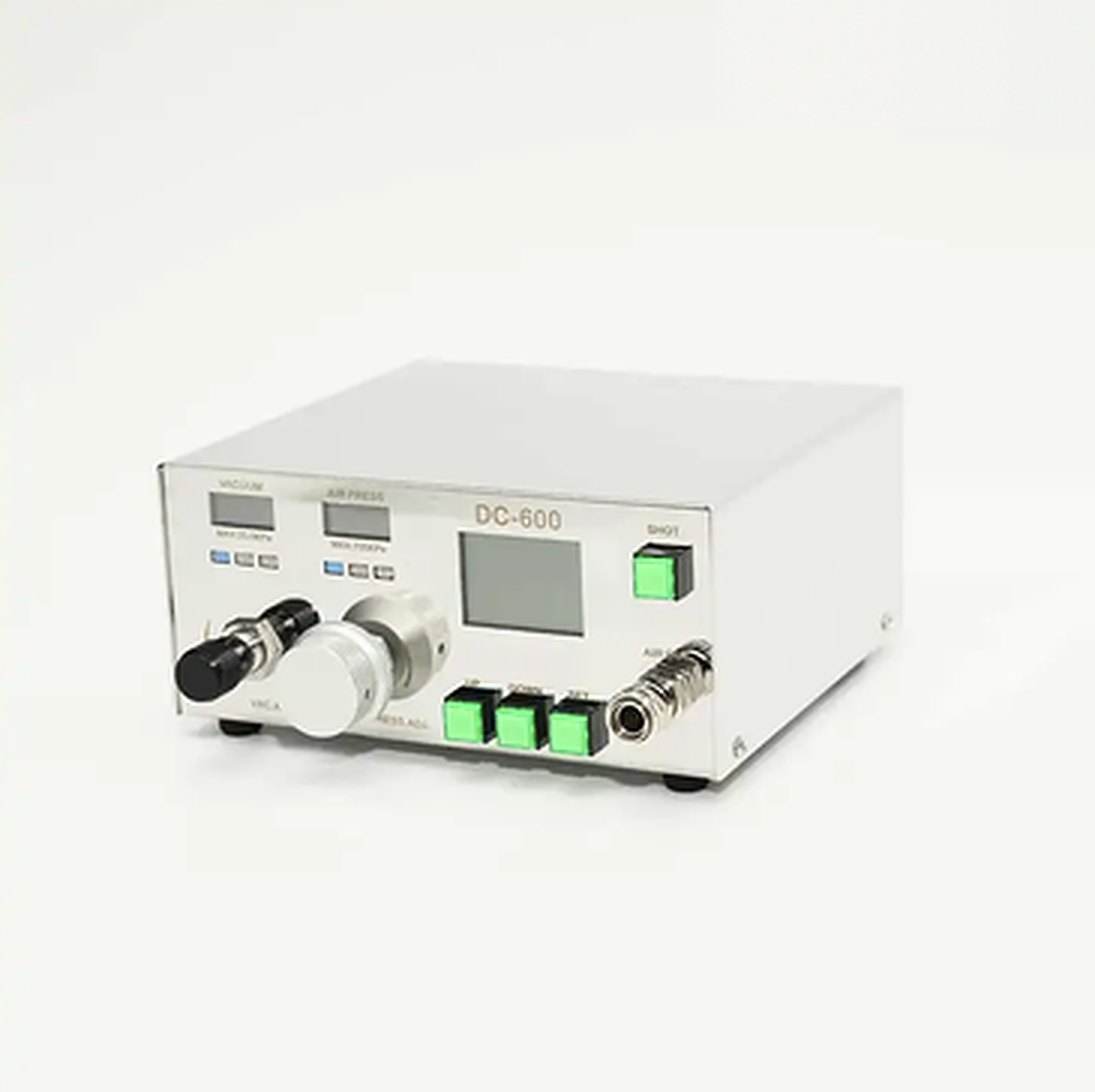
The DC600 is a precision automatic dispensing controller designed for highly repeatable adhesive dispensing in electronics manufacturing: fixing components on PCBs, potting connectors and bonding small plastic parts. It finely controls pulse width and pressure, accepts common valve types, stores recipes for quick product changes and offers digital and serial interfaces for in-line integration and traceability.
Fine control suited to fine-pitch PCBs and adhesive dots on connectors.
15 W benchtop controller, easy to integrate and low in energy consumption.
Save and quickly recall settings to change product in an instant.
Several inputs/outputs and serial communication options for in-line integration.
Combined with fast valves and proper tuning, the DC600 limits adhesive stringing and deposit scatter.
The problem
In electronics assembly, an irregular adhesive volume or placement leads to rework, failures and additional costs.
The cause
Insufficient pressure resolution, slow valve, viscosity varying with temperature and no in-line control.
The DC600 answer
Fine tuning of pulse and pressure, compatibility with fast valves and recipe storage stabilise dispensing.
| Dispensing method | Pulsed pneumatic | Dispensing channel | Single channel |
| Dispensing modes | Timed (TIMED) / linked (LINKAGE) | Dispensing time | 0.01 to 99.99 s |
| Input air pressure | 0.1 to 0.7 MPa | Output air pressure | 0.05 to 0.6 MPa |
| Power supply | 220 V AC, 50 Hz | Power | 15 W |
| Dimensions (W × D × H) | 245 × 192 × 95 mm | Weight | 2.5 kg |
| Certification | CE · ISO | ||
Fixing components before soldering: less movement and less risk of the "tombstone" effect.
Even, reproducible beads to protect the contacts.
Consumer electronics and sensors: compact format for conveyors and automated cells.
The operator or the MES sends the pressure and pulse program to the controller.
The controller manages the pressure and pulse duration sent to the valve.
An in-line camera or flow sensor measures the deposit and feeds back the information.
Parameters and batch information recorded for traceability and quality.
Volume and tolerance: choose the valve and nozzle, and check that the controller resolution achieves the target repeatability.
Valve compatibility: confirm electrical and mechanical compatibility with your cartridges.
Integration: check the required protocols (digital I/O, RS-232/RS-485, Modbus) for the link with the PLC or MES.
Throughput: validate the pulse response time and cycle rate against the line takt time.
Environment: provide a suitable enclosure or IP rating in the presence of dust or humidity.
We can validate these points with you during trials in our laboratory. Discover our testing services
Commissioning: carry out 4- to 8-hour pilot trials to stabilise the process and confirm repeatability, then record the results.
Maintenance: clean the nozzles according to the adhesive manufacturer's recommendations; regularly check the valve seals and cartridges (every week on high-use lines).
Let's talk about your application
Tell us which fluid you dispense, at what rate and with what tolerance: we will propose the right configuration, a detailed quotation and, if you wish, a trial on your own parts in our laboratory.
CDS Electronique · Bussy-Saint-Martin (77) · Mon–Thu 9am–6pm · Fri 9am–12pm